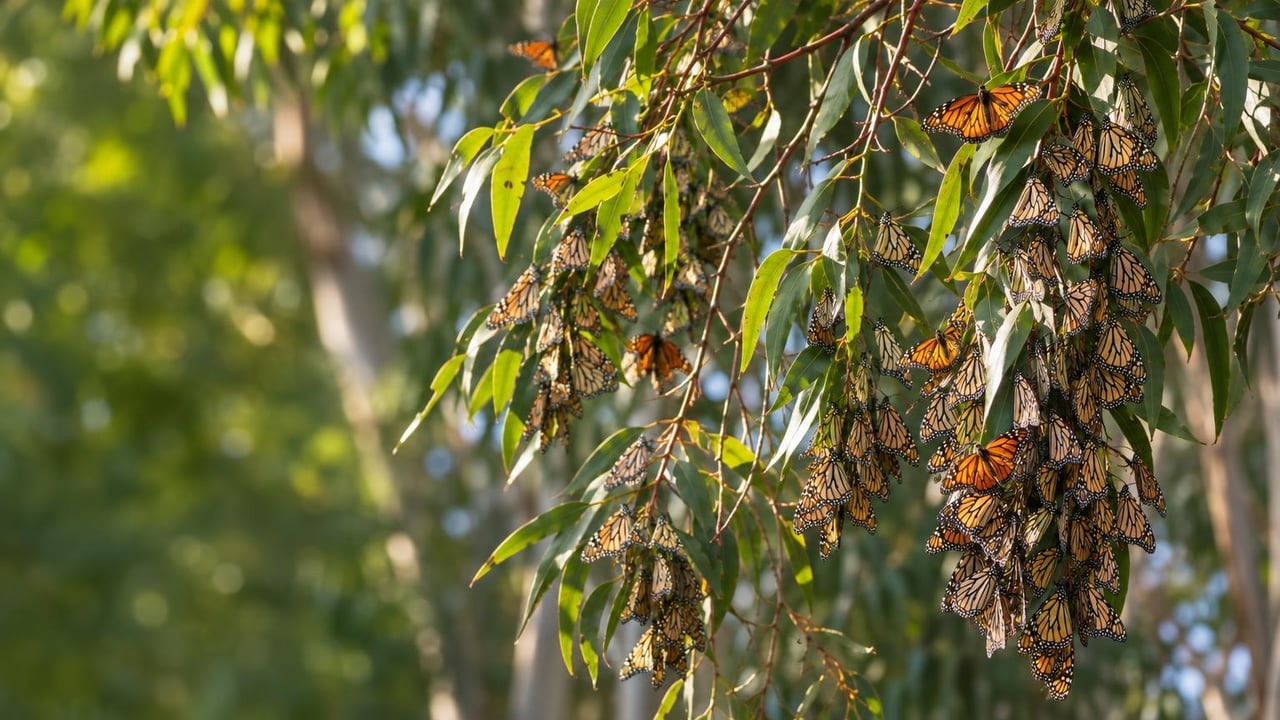
Andrea McMahon, a volunteer at Natural Bridges State Beach, tells visitors to pick out the big, thick tree and follow one branch all the way to its tip. In a Lookout Santa Cruz story published Nov. 22, she pointed people to what looked like a clump of shriveled leaves. Up close, it turned out to be about 30 monarch butterflies hanging upside down along a skinny branch.
People on the Westside have known about the grove for generations. Last season's count put it ahead of every other overwintering site in the West. In the Xerces Society's most recent Western Monarch Count, taken from late November through early December 2025, volunteers recorded about 12,260 monarchs across 249 sites in the West. Natural Bridges recorded 2,500 of them in early December, the season's highest count. That works out to roughly one in every five monarchs counted that season. The 2026 version of the same count runs from Nov. 14 through Dec. 6, so this holiday weekend falls right in the middle of it.
A Westside Grove Ahead of the Rest of the Coast
Set the Natural Bridges number beside the West's other well-known groves and the gap is clear. In the same mid-season count of late 2025, Xerces reported 188 monarchs at the Pacific Grove Monarch Sanctuary in Monterey County and 471 at the Pismo State Beach Monarch Grove in San Luis Obispo County. On the 2025 count, the grove off West Cliff was more than five times the size of Pismo's and more than thirteen times the size of Pacific Grove's.
It is also a much smaller crowd than this grove once held. Kirk Crane, a docent at Natural Bridges, told KAZU in October that the park had 120,000 monarchs in 1997, with clusters "the size of you and me." Across the whole West, Xerces ranks the 2025 tally of 12,260 as the third-lowest since the count began in 1997, after 1,901 in 2020 and 9,119 in 2024.
Even in a low year, 2,500 of the monarchs that reached the coast chose this one eucalyptus canyon on the Westside. Lily Aravanis, a California State Parks interpreter at Natural Bridges, explained the appeal to Lookout: "We're kind of a Goldilocks spot. We're near the coast where it's never gonna freeze. We have rings of trees to provide wind block, and they also have a bit of a hole in the middle so the sunlight can come through in the middle of the day." The eucalyptus also flowers in winter, which gives the butterflies food close at hand. Natural Bridges is the only State Monarch Preserve in California.
Why This Week and the Next Two Matter
Last season's figures show the timing as clearly as the scale. In its December 2025 coverage, the Santa Cruz Sentinel reported 1,210 butterflies counted as of the Nov. 13 early-season count. By early December, Natural Bridges alone stood at 2,500. After that the numbers fell. The late-season count, which ended Jan. 11, 2026, found 6,464 monarchs across 193 western sites, 47% below the mid-season figure. Xerces calls that kind of drop typical and puts the range over the past ten years at 35% to 58%.
Visit Santa Cruz County, quoting a docent naturalist, gives the same seasonal pattern. Monarchs arrive at Natural Bridges in mid-October, numbers peak in late November and early December, and the butterflies leave between mid-January and February. State Parks says late October and all of November are often the best time for a walk through the grove. The two descriptions overlap right around this holiday weekend.
This season's numbers are already coming in. McMahon told Lookout that "we've got 1,400 butterflies here now, considering the loss of the trees, is probably good." Her figure is a volunteer's estimate made before the peak. The mid-season count now underway will produce the official 2026 number, and Xerces published last season's results in late January.
The 2026–27 season calendar:
| Date | What happens |
|---|---|
| Oct. 17 to Nov. 1, 2026 | Xerces early-season count |
| Nov. 14 to Dec. 6, 2026 | Xerces mid-season count, formerly the Thanksgiving count |
| Dec. 26, 2026 to Jan. 10, 2027 | Xerces late-season count |
| Feb. 13, 2027 | Migration Festival at Natural Bridges |
The Migration Festival date comes from Assemblymember Gail Pellerin's fall newsletter. Lookout reports that the monarchs usually stay at Natural Bridges until around Valentine's Day, when the park marks the end of the season with that festival.
Reading the Weather Before You Go
The forecast decides whether you see clusters or butterflies in flight. Aravanis told Lookout that monarchs can't fly when it's below 55 degrees, so the sunniest hours are the best bet for seeing them move. State Parks says the butterflies cluster together in the eucalyptus on chilly days below 60 degrees. In practice, a cool, gray Friday morning after Thanksgiving is more likely to show the hanging clusters that look like dead leaves. A clear afternoon later in the weekend is more likely to show orange wings drifting through the gap in the canopy.
The clusters are easy to miss. "A lot of people go into the grove and they say, 'I didn't see any butterflies,' but they're just camouflaged really well," Aravanis said. Visit Santa Cruz County notes that volunteers are often in the grove to help visitors find them. McMahon's method is the one to use. Pick a large tree, follow a single branch out to its end, and wait for movement.
This winter adds one more factor. KAZU reported in October that State Parks and Xerces are watching this season's El Niño closely. Rhiannon Sims of the State Parks Santa Cruz District noted that a big storm can be more than the grove's wind shelter can handle. In a season where storms may cut the count short, an early visit makes even more sense.
The Practical Side of the Visit
Natural Bridges is open from 8 a.m. to sunset. The visitor center is open 11 a.m. to 4 p.m. daily from Oct. 1 through Jan. 31. The vehicle day-use fee is $10, or $9 for seniors 62 and older. A wheelchair- and stroller-accessible boardwalk runs down to an observation deck in the eucalyptus grove. If family is visiting for the holiday, the boardwalk works for grandparents and strollers alike.
For residents who want to do more than look, there are three ways in.
The count itself relies on volunteers. Xerces requires everyone who takes part to register each year.
Last winter, Xerces and State Parks put ultralight radio tags on monarchs in Santa Cruz. The Sentinel reported that anyone running a scan with the Project Monarch Science app can pick up tagged butterflies within Bluetooth range, and that tags had already pinged in Capitola and at Lighthouse Field State Beach.
Gardens make a difference too. Entomologists quoted by the Sentinel recommend planting fall and winter blooms in Santa Cruz County, because overwintering monarchs leave their clusters two or three times a week to feed. They also advise planting milkweed more than 5 miles inland. Milkweed closer to the coast can lead monarchs to settle in a resident population that is more exposed to a wing-deforming parasite. For a Westside or Seabright yard, that means nectar plants that bloom in winter, with the milkweed left to gardens farther inland.
Our Santa Cruz neighborhood guide covers more of the town's seasonal routines, and our August piece on downtown Santa Cruz's storefront revival has lunch ideas for after a morning in the grove.
Melanie Kemp brings more than 40 years of Bay Area real estate experience to clients who want to live close to places like this grove. If a Westside walk this weekend has you thinking about a home nearer the coast, or about what your current home is worth, request a confidential home valuation and we'll talk it through privately.